
Complex technology transformation is usually discussed in terms of strategy, innovation and value creation.
All of those matter.
But after many years working across cloud and infrastructure transformation, data-centre migration, enterprise applications and M&A-driven change, I have reached a fairly simple conclusion about where CTO attention needs to start:
Risk first. Cost second. Value third.
Not because value is less important. Quite the opposite.
But you cannot realise value sustainably if you lose control of the first two.
Running through all three is something even more fundamental:
Decision quality.
Complex transformation is not about perfectly predicting a multi-year journey before setting off. It is about understanding enough to make good decisions, acting deliberately, validating what actually happens and changing course when the assumptions behind the plan no longer hold.
The CTO Transformation Dashboard
Four questions provide a simple executive lens through which to view a complex transformation.
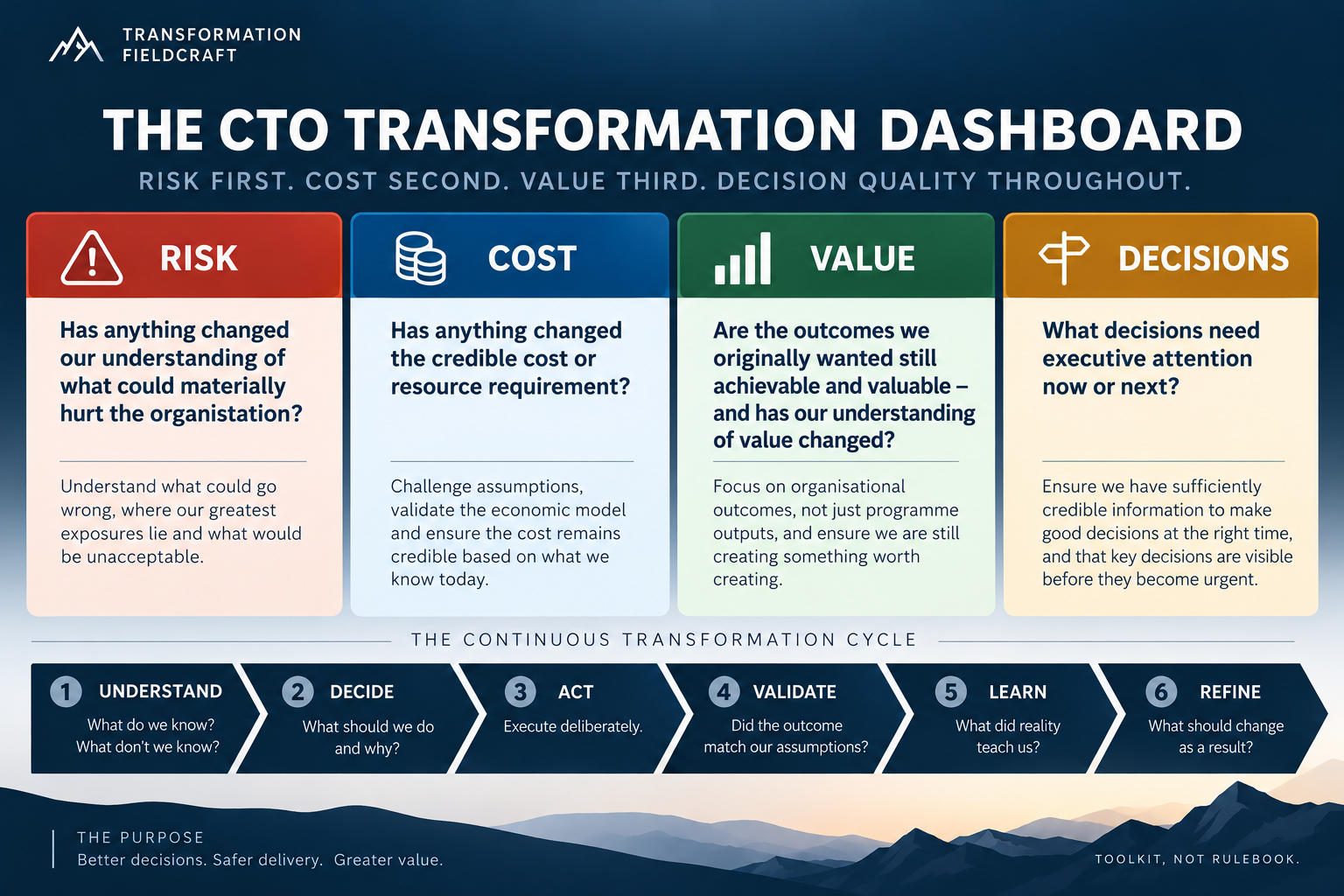
The four lenses are not independent.
A change in risk may affect cost. A change in cost may require a decision. That decision may alter the value case. A change in expected value may, in turn, change the organisation's appetite for cost or risk.
The purpose of the Dashboard is therefore not simply to report status.
It is to keep asking:
What has changed that might require us to think differently?
1. Risk: understand before you act
One of the most dangerous characteristics of complex transformation is not complexity itself.
It is unseen complexity.
Large technology estates accumulate dependencies over many years: applications, infrastructure, integrations, business processes, operational practices, vendors, data flows and people.
Many of those relationships are poorly documented or understood.
That creates a simple leadership problem:
How can you make a good transformation decision if you do not yet understand what you are changing?
This is why discovery is not merely a planning activity. It is a risk-management activity.
The objective is not to remove every uncertainty before acting. That is rarely possible.
The objective is to understand enough of the landscape to identify where uncertainty could materially hurt the organisation.
Complexity itself isn't necessarily dangerous. Unseen complexity is.
From experience
On one large enterprise cloud-migration programme, a complex warehouse-management platform formed part of the application estate being assessed for migration.
The assessment went well beyond the technology itself. We looked at the application footprint, infrastructure, dependencies, integration points, business processes it supported and the parts of the organisation that depended upon it.
The conclusion was that the platform could be migrated. There was no fundamental technical blocker.
But it was also clear that it would be one of the more complex migrations in the portfolio.
Rather than tackling it early, the decision was made to position it later in the migration window. Simpler workloads would move first, allowing the delivery approach to mature and lessons to be incorporated before tackling one of the more complex platforms.
Risk management doesn't always mean avoiding complexity. Sometimes it means choosing when to confront it.
2. Cost: challenge assumptions, not the need to estimate
Transformation programmes need early estimates.
Executives need to understand whether an initiative is likely to cost £1 million, £10 million or £100 million before committing significant resources.
So early estimation is necessary.
The problem comes when an early estimate becomes treated as though it were a fact.
On another large cloud-migration programme, significant planning had already taken place before I joined. A technical-complexity model had been developed which assigned nominal migration costs to applications based largely on their technical characteristics.
It was a perfectly reasonable starting point.
But detailed discovery revealed something important.
Some applications that appeared technically straightforward were operationally difficult to migrate.
Migration windows were constrained. Business processes could not easily be interrupted. Users were geographically distributed. Dependencies extended beyond the application itself. Coordination requirements were significant.
The technical migration might have been simple.
The transformation was not.
Technical complexity tells you how difficult something is to change. Operational complexity tells you how difficult it is to change safely.
As discovery improved our understanding of the estate, the original cost assumptions had to be revisited.
That does not mean the early estimate was wrong.
It means the estimate reflected what was known at the time.
The mistake would have been pretending that better information should not change it.
A budget is a constraint. It isn't evidence that the transformation can be delivered for that amount.
A credible cost journey therefore looks more like:
Mandate assumptions → Initial cost model → Discovery → Credible delivery complexity → Material variance → Options → Decision → Revised baseline
When material variance appears, leadership has choices.
Those choices may include scope, sequencing, timescale, architecture, delivery model, resource profile, transitional solutions, risk appetite or additional funding.
The important point is that variance should trigger a decision, not denial.
The mistake isn't estimating early. You have to estimate early. The mistake is treating an early estimate as though better information can't change it.
3. Value: don't confuse the deliverable with the outcome
Transformation programmes often begin with a relatively narrow value proposition.
Reduce cost.
Exit a facility.
Move to the cloud.
Separate a business.
Integrate an acquisition.
Those objectives provide the initial mandate.
But they do not necessarily describe the full value that can ultimately be created.
One data-centre transformation I worked on began predominantly as a cost-reduction exercise.
The organisation needed to exit a legacy facility and reduce the associated operating cost.
That remained an important objective throughout the programme.
But as the transformation developed, the strategic destination provided additional benefits: improved resilience, stronger operational processes, greater standardisation, improved support arrangements and reduced technology risk.
The value proposition had evolved.
That was not scope creep.
It was a better understanding of what the transformation could achieve.
The value progression looked broadly like this:
Initial value: Reduce operating cost
Transformation: Exit legacy environment
Strategic destination: Corporate platform
Additional value: Resilience, operational maturity, standardisation and reduced risk
This distinction matters because programme teams can become overly focused on completing the technical deliverable.
The servers moved.
The platform deployed.
The data centre closed.
The separation completed.
But:
Programme completion isn't the same thing as value realisation.
The leadership question should therefore remain:
What will genuinely be better when we're finished?
And that question should be revisited as understanding improves.
Don't confuse the reason you started the transformation with the full value you can create from it.
4. Decisions: preserve the objective, not the original plan
Complex transformations rarely proceed exactly as originally designed.
Dependencies change.
Timelines move.
Commercial constraints emerge.
Technical assumptions prove wrong.
Business priorities shift.
When that happens, one of the most dangerous behaviours is continuing to defend the original plan simply because it was approved.
On one major data-centre migration, the original strategy was to move workloads directly from the existing facility to their long-term strategic destinations.
That was the cleanest technical solution.
But circumstances changed.
The required facility-exit timetable no longer aligned safely with the time needed to complete every strategic migration directly.
Leadership therefore faced a choice.
Force the original plan and accept increasing delivery risk.
Or recognise that the assumptions behind the plan had changed.
The solution was to introduce an intermediate destination for some workloads.
Technically, this was inefficient.
Some systems would effectively be moved twice.
From a transformation perspective, however, it was the credible option.
It separated two objectives that could no longer safely be achieved simultaneously:
- Exit the existing facility within the required timeframe.
- Complete the strategic migration properly through a controlled second stage.
Sometimes the least elegant technical solution is the safest transformation solution.
The lesson is broader than data-centre migration.
When the assumptions behind a plan change, continuing to follow the plan is not necessarily control.
Sometimes control means making a new decision.
Transformation leadership isn't about defending yesterday's plan. It's about preserving today's objective.
The four lenses work together
Risk, Cost, Value and Decisions should not be treated as separate governance conversations.
They form a connected system.
Risk → Cost → Decision → Value → Risk...
Discovery may expose a new risk.
That risk may increase the credible delivery cost.
The cost variance may require an executive decision.
That decision may alter the expected value or delivery approach.
And that revised value proposition may change the organisation's appetite for cost or risk.
Good governance therefore does more than track whether milestones are green, amber or red.
It identifies when reality has changed enough to require a new decision.
The real currency of complex transformation is decision quality.
A different way of thinking about transformation
The practical cycle I use is:
UNDERSTAND → DECIDE → ACT → VALIDATE → LEARN → REFINE
UNDERSTAND
What do we know?
What don't we know?
What are we assuming?
DECIDE
What does the evidence tell us?
What trade-offs are we making?
Why is this the right decision now?
ACT
Execute deliberately.
Make the decision real.
VALIDATE
Did the outcome match the assumptions?
What actually happened?
LEARN
What did reality teach us?
What do we now know that we did not know before?
REFINE
What needs to change as a result?
Then repeat the cycle.
This does not replace Agile, Waterfall, PRINCE2 or any other delivery method.
It sits above them.
It is a way of thinking about transformation when uncertainty cannot be designed out at the beginning.
The CTO's Monday Morning Test
A useful way to test whether a transformation remains under genuine control is to ask seven questions:
- What have we learned recently that changes something we previously believed?
- What is the biggest thing we still don't understand?
- What could hurt us most if we're wrong?
- Is our current cost still credible?
- What important decision is coming next?
- What evidence will tell us we're ready to proceed?
- What will genuinely be better when we're finished?
Those questions create a very different executive conversation from:
Are we on track?
Bringing it back to the Dashboard
The CTO Transformation Dashboard can therefore be reduced to four continuing executive questions:
RISK
What could materially hurt us — and has our understanding changed?
COST
Is the economic model still credible based on what we now know?
VALUE
Are we still creating something worth creating — and has our understanding evolved?
DECISIONS
What needs deciding now or next?
Underneath all four sits the same cycle:
UNDERSTAND → DECIDE → ACT → VALIDATE → LEARN → REFINE
Complex technology transformation isn't about perfectly predicting a multi-year journey before setting off.
You won't.
It's about creating enough understanding to make good decisions, acting deliberately, learning from what actually happens and changing course before uncertainty becomes failure.
The plan matters. But reality matters more.
Toolkit, not rulebook.